Featured

Between Machines and Wood

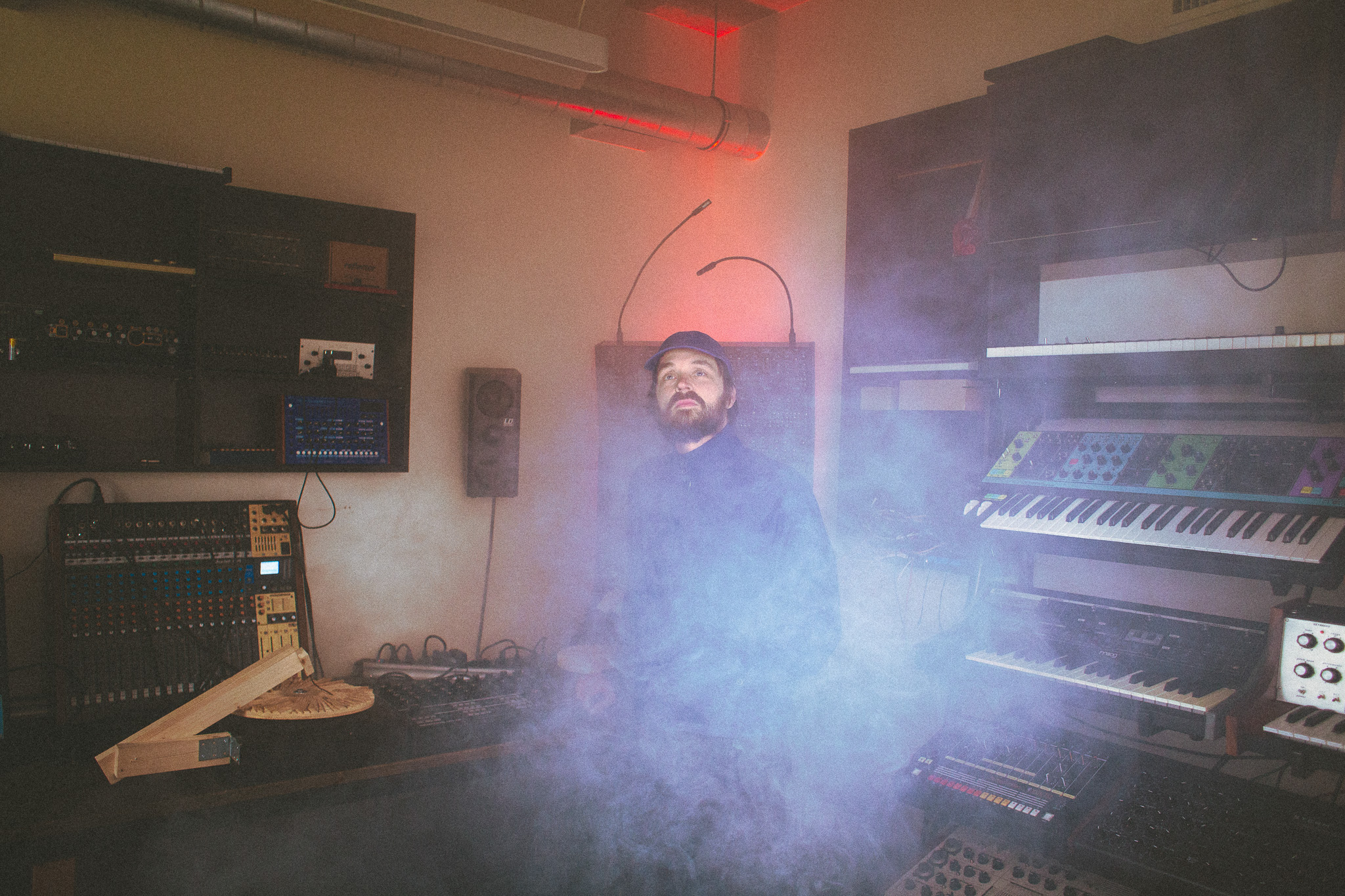
Andreas Trobollowitsch’s residency at Erica Synths Garage felt less like traditional sound design and more like an ongoing experiment in movement, texture and controlled unpredictability. A Vienna-based electroacoustic musician, composer and sound artist, Andreas works at the intersection of sound, visual art and mechanics - building self-developed instruments and exploring rotation, physical processes and unconventional ways of producing sound. During his stay, wooden turntables met drum machines, mechanical systems collided with synthesisers, and ideas developed through curiosity rather than fixed outcomes. After his residency with us, we sat down to talk about modified instruments, controlling chaos, and why not knowing exactly what will happen is often the best place to start.

-Where would you say your journey in music really started? Was it formal education, childhood, maybe?

AT: It started in childhood, yes. I grew up in the countryside in Austria, surrounded by traditional Austrian music. My brother played in a local folk music band. I was around 10 or 11 years old when they needed a bass player, so I stepped in. We played at weddings and similar events, mostly as a cover band. That was probably my first real experience making music.

Later, when I was around 16, a friend moved from Vienna to the village where I lived. He listened to a lot of heavy metal, like Machine Head, Slayer, and that kind of thing. So from one day to the next, I started playing in a metal band too, because they were looking for a bass player. After that, I did another project that was more like trip hop. Over the years, I was involved in so many different things. At some point, I studied musicology and jazz bass in Vienna. In musicology, I met people who were into experimental music, and I think that’s more or less how my path developed.

-What would you consider the core principles or fundamentals of your work, and are there any ongoing patterns or themes that have stayed from the beginning till now?

AT: I’d say it’s a lot about rotation and visual aspects, also about traceability, like being able to follow how the sound is produced. There’s often a focus on mechanical sound production, even if the output sounds electronic or electronically generated. That’s definitely a key element for me.

The visual aspect is important too, in terms of how things move or how they’re set up in a space. I think the rotation part ties into that visual aspect - it’s about how things rotate and how that interacts with the space around them.

-So the aesthetic aspect of your performances is as important as sound?

AT:I think it’s super important - yes, definitely. Because, you know, when you go to a concert, nobody keeps their eyes closed the whole time. Maybe for a few minutes, but not the entire time. So it’s not just about listening; the visual aspect opens up the imagination too.

If it’s just a computer, it doesn’t really matter visually. But if it’s something mechanical or more physical, it becomes part of the experience. For me, it’s really in the intersection of music and visual art.

When I do exhibitions, it’s all about that visual aspect as well. I try to treat everything on the same level - sound, visuals, and concept. Actually, I think at the center of it all is having a clear concept. I always start from a strong concept, and then I build the work from there.

-Throughout your career, you have used all kinds of self-made or prepared instruments. What draws you to these unconventional sound sources?

AT: It’s about finding out. I’m curious about how things will sound if I try them out. If I already knew how they would sound, I wouldn’t bother. So it’s really driven by curiosity - like a child, in a way. I want to experiment because I don’t know exactly what will happen.

For example, with the turntable I’ve been using, it wasn’t the first version. There were earlier versions, and then I thought, “Okay, maybe I can find some patterns or rhythms in there.” It’s this constant curiosity that drives me.

-You recently performed at the modern music festival Decibels in Riga with your mechanical wooden turntables and a string quartet from Sinfonietta Riga. Could you explain the story of how you ended up in Latvia with this project, and how did the performance go?

AT: I first came to Riga last year. After a busy period of projects, I had some time off in June and thought, “Let’s just go somewhere without any work commitments and see what people are doing.” I went to see Anna Fišere composition, and also visited Latvian festival Skaņu Mežs. She introduced me to many people, including Armands from the Sansusī Festival, where I’ll be playing in August - turntables, flutes, a bigger installation, and a choir. I’m really looking forward to that one.

Anna Became the curator of Decibels and invited me to perform. She also connected me with people from the Baltic Analog Lab. She asked if I could not only perform but also do a masterclass, and a few other things - it was quite intense but also super exciting. Teaching a masterclass in front of composition students at the university was a completely new experience for me.

About the collaboration itself: it was definitely challenging. When you don’t know the musicians, it’s always a bit tough. I prepared a recording and a simulation to show how I wanted it to sound. Normally, I like to spend time with the musicians alone, exploring what sounds they can produce. But we only had two rehearsals, which is pretty normal in these situations. Of course, when you work with people you know well, you can go much deeper into the details. But when you don’t know them, you have to keep it a bit broader.

It was very challenging because I had to control my own mechanical turntable setup and interact with the quartet. It’s performance, composition, and exhibition all at once, and you have to perceive all those layers. Sometimes I thought it would be great if I could just control every musician, telling them exactly what to play at every moment!

-Explain your setup here - what instruments are you using, and why? What’s going on?

AT: Well, what I’m doing here is really an extension of the same idea. I don’t want to say the synthesizer is replacing the string quartet, but in a way, that’s exactly what’s happening.

Earlier, I mentioned that I was thinking about how nice it would be to control every second of a performance. Now, with a synthesizer, I can kind of do that. I’ve never really played synthesizers before, but I found it super interesting. I’m trying not to get lost in all the possibilities - it’s about getting to the essence of what I want to realize in sound, or the soundscape I imagine.

I’ve found a way to avoid going too deep into creating many patterns, I'm just using one preset and focusing on the details: adjusting speed, color, and so on. I’m treating the Pērkons HD-01 in the same way I treat the turntables, focusing on speed and texture changes. The big difference is that I can also control the volume. With the turntables, if I make them louder, it just becomes more aggressive - I can’t keep the same sound texture and just make it louder.

It’s almost like a collaboration between wood and synthesizer - a kind of symbiosis between organic and electronic. My setup has about four or five sound sources: three turntables and two drum machines. I can control all of them in terms of speed, and I see it as creating a kind of “culture scene.” I’m trying to find one preset and then focus on changing the small details within it.

-Are there any elements or techniques that you’ve adopted during the stay that you’d like to carry forward or explore more after this residency?

AT: Yeah, definitely. All the synthesizers have come as a kind of a relief, honestly. With my mechanical setups, I’m always fighting for the sounds - it’s a lot of work, and you have to be super focused all the time. With a machine, you just press a button, and boom - it’s there. It’s a completely different feeling because you can rely on the machine to handle that part.

So I was thinking that maybe I’ll create a setup with synthesizers or machines where I can still control the speed, pushing it much further until it becomes more of a sound itself. That would be perfect.

-How did you enjoy Riga? Did you have a chance to experience the local music scene? And if so, what were your impressions?

AT: Yeah, I went to a lot of places, actually. What I really liked is that there’s a lot of support going on between different disciplines, from classical composers to Erica Synths, to photography, to Skanu Mežs. Everyone seems to be supporting each other, and that feels super good. I don’t know many other cities where you feel that kind of connection.

I also noticed that people here are still hungry and open to new things. In other cities, sometimes it feels like everyone is already full of everything, they think they’ve seen it all, which isn’t really true, but it creates this attitude where everything feels boring. In Riga, there’s still a freshness and openness, and I think that’s really important to keep alive.

-We are just starting to get hungry!

AT: I know what you mean. It’s interesting, because I’ve been telling people about it too. A few months ago, I was in Austria, and I told some friends I was going to a concert. They asked me, “Where are you going next?” and I said, “Riga.” And they were like, “Riga? Everyone’s going to Riga! What’s happening there? What are you doing?”

Even a friend of mine who’s working with this ambisonics system - he was at a festival in Italy, and he also ended up here in Riga. So yeah, there’s definitely something going on here!

You may also like

Mixhell_249.jpg
July 10, 2020 · INTERVIEWS

MIXHELL

Martin-Gore-Col-1-Travis-Shinn.jpg
July 22, 2020 · INTERVIEWS

Martin Gore

HH.jpg
Aug. 18, 2020 · INTERVIEWS

Headless Horseman